

30 Circle Time Activities for Preschool, Plus a Planning Worksheet
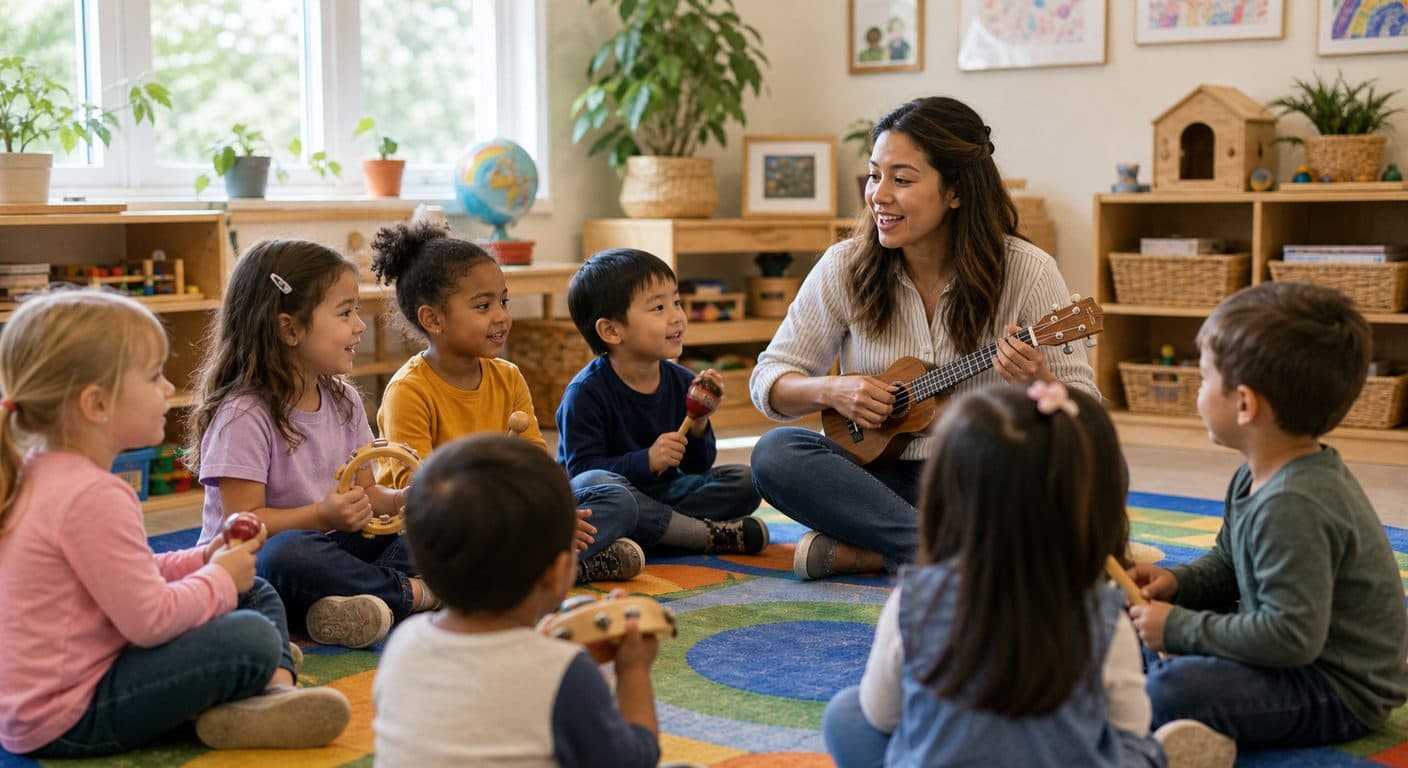
Choose circle time activities around what your group can enjoy and participate in today. A brief greeting, a movement game and a shared story can be a useful starting plan; adjust it as you observe the children.
These 30 ideas offer ways to practice conversation, observation, movement and turn-taking. They are activity suggestions, not tested outcomes or a requirement to complete a fixed-length group session.
Why Circle Time Matters
Circle time can provide opportunities to practice:
- Listening and attention: Following along in a group setting
- Social skills: Taking turns, waiting, responding appropriately
- Language development: Vocabulary, conversation, expression
- Community building: Creating classroom culture and belonging
The Circle Time Framework
Try a predictable sequence, adapting the length to the group:
- Opening ritual: Song, greeting, or routine
- Active engagement: Movement, games, interactive content
- Focus time: Story, discussion, or learning content
- Transition: Song or activity leading to next part of day
Mix active and calm activities. If children are squirmy, add movement. If the group is overwhelmed, reduce noise and offer a quieter option.
Opening Activities (Gathering & Greeting)
1. Name Ball Toss
Sit in a circle and roll or toss a soft ball to a child while saying their name. That child tosses to the next, saying the new child's name.
Practice opportunity: Children practice name recognition and waiting for turns.
2. Good Morning Song with Sign Language
Sing a simple good morning song while using gestures everyone can choose to copy. If you use ASL, learn the signs from a qualified source rather than inventing signs.
Practice opportunity: Adds movement, teaches useful signs, and welcomes everyone.
3. Weather Reporter
Each day, a different child looks out the window and reports the weather. Use a simple weather chart with movable pieces.
Practice opportunity: Builds observation skills and gives each child a special job.
4. Feelings Check-In
Show pictures of different emotions. Children point to or share how they're feeling today. No judgment—just acknowledgment.
Practice opportunity: Builds emotional vocabulary and shows children their feelings matter.
5. Mystery Greeter
One child hides their eyes while another says "Good morning!" The first child guesses who spoke based on voice alone.
Practice opportunity: Builds listening skills and gives children a guessing game.
Movement Activities
Sitting still is hard for preschoolers. These activities get wiggles out while building skills.
6. Head, Shoulders, Knees, and Toes (Variations)
Beyond the classic, try:
- Whisper version (increasingly quiet)
- Super slow version
- Backwards (toes, knees, shoulders, head)
- Replace body parts with silly words
Practice opportunity: Familiar song with built-in variety keeps it fresh.
7. Freeze Dance
Play music while children dance. When music stops, everyone freezes. Vary the freeze poses—freeze like a tree, freeze like you're surprised.
Practice opportunity: Practices self-regulation (stopping when the body wants to keep moving).
8. Animal Movement Cards
Draw cards showing different animals. Children move like that animal around the circle—hop like a frog, slither like a snake, stomp like an elephant.
Practice opportunity: Builds gross motor skills and offers many variations.
9. Pass the Squeeze
Offer a choice of passing a wave around the circle or, with each child willing, a gentle hand squeeze. A wave-only version needs no touch. Keep the pace comfortable.
Practice opportunity: Builds community and practices gentle touch.
10. Mirror, Mirror
Children pair up facing each other. One leads, one mirrors their movements. Switch leaders.
Practice opportunity: Builds focus, attention, and social connection.
11. Body Part Beanbag
Call out a body part—children place their beanbag on that body part. Start easy (head, foot) and progress harder (elbow, knee, shoulder).
Practice opportunity: Teaches body part vocabulary through movement.
12. Stretching Story
Tell a story with built-in movements: "The bear woke up and stretched SO tall (reach up). Then he reached for berries on the ground (bend down)..."
Practice opportunity: Connects literacy with physical activity.
Interactive Games
Games that involve everyone keep attention high.
13. What's Missing?
Place 3-5 objects on a tray. Children close eyes while you remove one. Who can identify what's missing? Increase difficulty over time.
Practice opportunity: Builds visual memory and attention to detail.
14. I Spy (Circle Time Version)
Choose an item visible to all children. Give clues: "I spy something that is red and round." Children guess.
Practice opportunity: Builds vocabulary, listening skills, and observation.
15. Hot and Cold
Keep everyone in the supervised space. Hide a large object behind a screen while the finder looks away. The group gives spoken or visual clues as the child searches within a defined area.
Practice opportunity: Builds spatial awareness and group cooperation.
16. Story Chain
Start a story: "Once upon a time, there was a very silly dog." Point to the next child to add one sentence. Continue around the circle.
Practice opportunity: Builds narrative skills and listening (each child must know what came before).
17. Telephone
Classic whisper game. Start a simple phrase and pass it around the circle. Compare the end result to the original.
Practice opportunity: Teaches careful listening and offers a chance to notice how a message changes.
18. Mystery Box
Hide an object in a box with a hole. One child reaches in and describes what they feel (without looking). Others guess.
Practice opportunity: Builds descriptive vocabulary and sensory awareness.
19. Sound Guessing
Record common sounds (doorbell, dog barking, car horn) or make sounds with hidden instruments. Children identify each sound.
Practice opportunity: Builds auditory discrimination and vocabulary.
20. Would You Rather?
Pose simple choices: "Would you rather be a fish or a bird?" Children move to different sides of the circle based on their choice.
Practice opportunity: Practices decision-making and lets children express preferences.
Calming Activities
After high-energy activities, calm the group before story time or transitions.
21. Breathing Buddies
Children lie down with a small stuffed animal on their bellies. They watch the animal rise and fall as they breathe slowly.
Practice opportunity: Teaches deep breathing in a child-friendly way.
22. Five Finger Breathing
Trace the outline of one hand with the pointer finger of the other. Breathe in going up each finger, breathe out going down.
Practice opportunity: Combines movement with calm breathing—keeps children focused.
23. Silent Ball
Pass a soft ball around the circle without talking. If the ball drops or someone speaks, pause and continue together. Nobody is eliminated; offer a roll or hand-to-hand pass.
Practice opportunity: Practices self-control in a game format.
24. Mindful Listening
Ring a chime or bell. Children raise their hand when they can no longer hear the sound. Repeat several times.
Practice opportunity: Focuses attention and creates calm.
25. Progressive Muscle Relaxation
Guide children to squeeze and release different muscles: "Squeeze your hands tight like you're holding a ball... now let go and feel them relax."
Practice opportunity: Teaches body awareness and stress release.
Learning-Focused Activities
Offer playful ways to explore letters, patterns and categories.
26. Letter of the Day Hunt
Introduce the day's focus letter. Children scan the room to find objects starting with that letter. Make a list together.
Practice opportunity: Builds letter-sound associations in a game format.
27. Counting Songs with Props
Sing "Five Little Monkeys" or "Ten in the Bed" with actual props or felt board pieces. Different children remove pieces as you count down.
Practice opportunity: Makes abstract counting concrete and involves everyone.
28. Pattern Dance
Clap-stomp-clap-stomp. Children continue the pattern. Increase complexity: clap-clap-stomp-clap-clap-stomp.
Practice opportunity: Teaches patterns through movement.
29. Graph the Group
Ask a question: "Do you have a pet?" Create a simple bar graph with children standing in groups. Count and compare.
Practice opportunity: Makes math real and personal.
30. Concept Sorting
Use hula hoops as Venn diagrams on the floor. Sort objects (or children!) into categories: "Things that are red," "Things that roll," "Things that are red AND roll."
Practice opportunity: Builds categorization skills visually and kinesthetically.
Troubleshooting Common Problems
Children Won't Sit Still
- Add more movement activities
- Shorten sitting time when participation or comfort changes
- Provide fidgets or cushions for children who need them
- Accept that some movement is normal and okay
One Child Dominates
- Use structured turn-taking (name sticks, going around the circle)
- Give dominant children special jobs that keep them busy
- Practice "wait time"—count to 5 before calling on someone
Children Talk Out of Turn
- Establish a visual signal for "my turn to talk" (holding an object)
- Use a clear visual turn cue and model listening without requiring silence from every child
- Praise children who wait appropriately
Attention Wanders After 5 Minutes
- Shorten activities
- Add transitions between activities (stand up, sit down, shake it out)
- Increase participation—passive listening loses attention
Some Children Never Participate
- Offer non-verbal ways to participate (pointing, nodding, movement)
- Don't force speaking—some children need more time
- Create special moments outside circle time to build confidence
Planning Your Circle Time
Sample 15-Minute Circle Time
| Time | Activity | Type |
|---|---|---|
| 2 min | Good morning song | Opening |
| 3 min | Weather reporter + calendar | Routine |
| 4 min | Freeze dance | Movement |
| 5 min | Story | Calm focus |
| 1 min | Transition song | Closing |
Weekly Variety
Rotate different activity types through the week:
| Day | Focus |
|---|---|
| Monday | Music/movement heavy |
| Tuesday | Game day |
| Wednesday | Social-emotional focus |
| Thursday | Literacy focus |
| Friday | Child choice + celebration |
Plan participation before materials
Offer a seated movement option, a way to point instead of speak, and permission to watch before joining. Avoid requiring touch, closing eyes or a particular body position. Adjust sound volume and provide visual cues alongside spoken directions. Choose large, age-appropriate props and inspect them before use.
The sample schedule above is an example, not a developmental target. If a game loses the group, end it and move on. Repeat a familiar favorite if that helps children join; variety is optional.
Use the circle time planning worksheet
Choose one focus, such as naming emotions or noticing a repeating pattern. Record the activity, materials, participation options, planned transition and a short observation afterward. The fictional example uses a seated weather report with picture choices. Its observation describes what happened rather than scoring children against one another.
Keep personal observations in your approved child-record process. A general planning sheet can say “picture choices helped participation” without naming a child. Next time, retain the useful adaptation and change only what needs adjustment.
Share something specific with families
A helpful update names the experience: “We made a clap-and-tap pattern and invited children to choose the next movement.” Avoid claiming the activity proves a child mastered a skill. Share photos only through your program's approved permissions and communication process.
Use the daycare daily report template to connect the activity to a useful family update. For another creative option, see preschool art projects. Explore Bloomily for preschools for the broader daily workflow.
Common questions
How long should circle time last? Adapt it to the group's participation and needs. The sample plan is not a required duration.
Does every child need to speak? Offer pointing, movement, picture choices or observation as ways to take part.
How should we use the worksheet? Plan a small selection of activities, record what helped participation, and use those observations for the next session.
Download the worksheet
Download the editable CSV worksheet. Open it in Excel, Google Sheets, or another spreadsheet application. The first data row is a fictional example; delete it before entering your own records. The file has no automatic calculations. Keep completed copies in your approved staff storage, not on a public link.