

A Circle Time Routine Preschoolers Can Count On: Calendar, Helpers and Class Rules
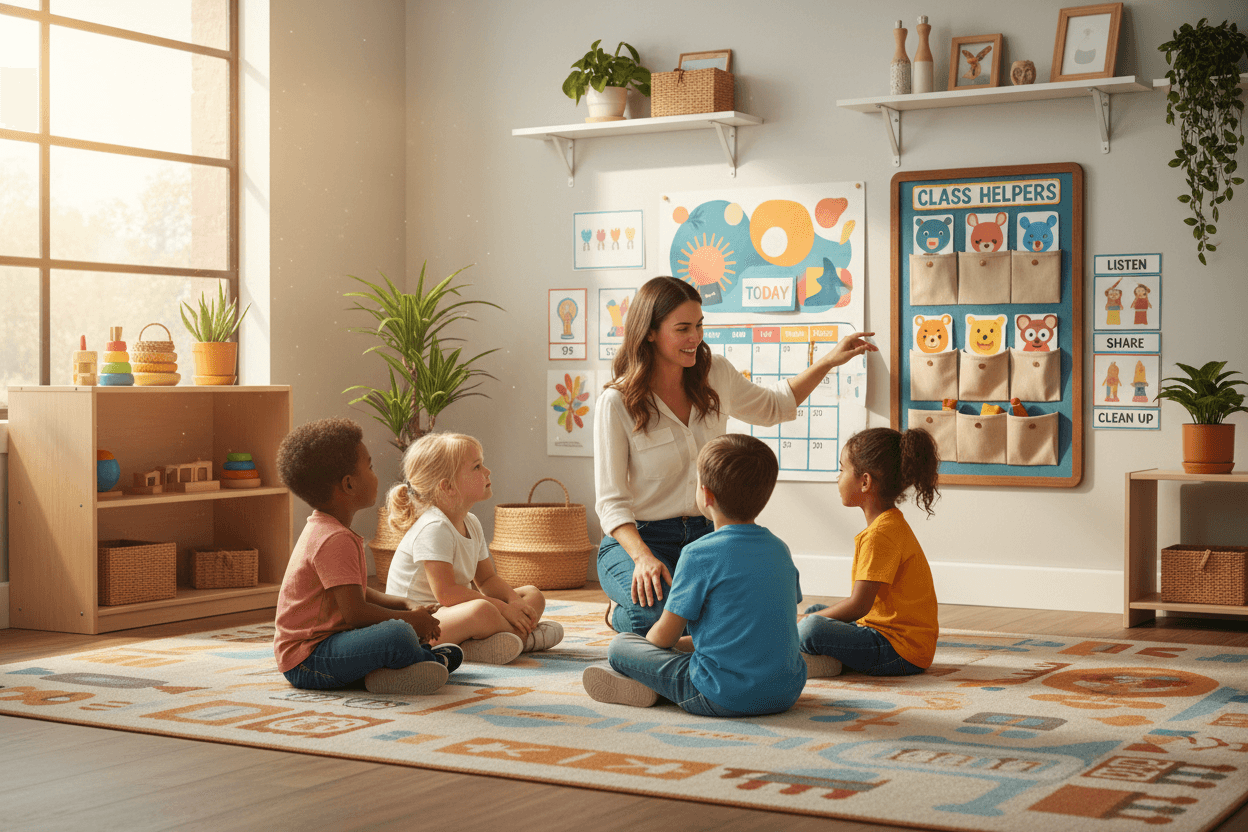
- A circle time routine that starts the same way every day helps children know what to expect and join in with confidence.
- Keep the anchoring part to about five minutes in a fixed order: hello song, calendar time, today's plan, then something new.
- Make calendar time hands-on and focused on today, yesterday and tomorrow rather than the whole month.
- Rotate helper jobs on a chart with names and photos so every child gets a turn, using pointing or a buddy when needed.
- Create three or four positive, picture-supported rules with the children, and word them so every child can follow them, such as 'We listen in our own way.'
New games and songs keep circle time fun, but the parts that stay the same matter just as much. When circle time starts the same way every day, children know what comes next, and that familiar start is comforting. Here's how to build a routine your class can count on: calendar time, helper jobs that rotate, and circle rules the children make themselves.
Why the same start every day helps
- Children know what to expect. A familiar first few minutes tells children that the day is starting the way it always does.
- It's easier to join in. A child who knows the steps can take part without waiting to be told how.
- There's more room for the new parts. Once the start feels familiar, a new game or story later in circle time feels exciting instead of confusing.
- Every child has something to look forward to. When helper jobs rotate, each child knows their turn is coming.
Keep the routine short and in the same order
The anchoring part of circle time works best when it's about five minutes long and happens in the same order every day. For example:
- A hello song. Use the same song every day.
- Calendar time. Today's day, the date and the weather.
- Today's plan. A quick look at the picture schedule.
- Something new. A game, a story or a question of the day.
Show the steps with pictures so children can see what comes next. The steps stay the same even when the activities inside them change.
Make calendar time hands-on
Calendar time works best when it's short and about things children can see and touch. Focus on today, yesterday and tomorrow more than the whole month.
- Find today. Children find today's square and add today's number.
- Sing the days of the week. Point to each day as you sing.
- Check the weather. Look out the window together and pick the weather picture.
- Count the days of school. Add one straw or craft stick each day, and bundle them into groups of ten.
- Count down to something special. Cross off the days until a field trip, a visitor or a class celebration.
If children start to drift, finish the step you're on and move to the next part. A short calendar time they enjoy is better than a long one they sit through.
Calendar helper jobs to share
Give a few children a job each day and rotate the jobs so everyone gets turns. A helper chart with each child's name and photo or picture shows whose turn it is today. Here are jobs children can do:
- Day helper: points to today's day and leads the days-of-the-week song.
- Date helper: adds today's number to the calendar.
- Weather reporter: looks outside and picks the weather picture.
- Counting helper: adds today's straw and leads the group in counting the days of school.
- Pattern helper: adds the next shape or color to the calendar's pattern.
- Schedule helper: puts today's picture schedule cards in order.
- Countdown helper: crosses off a day on the countdown to something special.
- Song leader: picks the hello song or leads the goodbye song.
Every job can be done by pointing or with a buddy, so every child can take a turn.
Make circle rules together
Children remember rules they helped make. Make your circle rules together near the start of the year, and look at them again whenever circle time needs a reset.
- Ask the class. "What helps everyone enjoy circle time?" Write down children's ideas in their own words.
- Pick three or four. Choose the ideas that matter most and say each one as what to do, not what not to do.
- Add a picture to each rule. Post the rules where everyone can see them, at children's eye level.
- Turn them into a chant. Many classes use a short chant, such as "Eyes to see, ears to hear, a turn to share, and friends are near." Let your class make up its own.
- Point, don't lecture. When a rule is hard to follow, point to its picture as a reminder and practice it together another day.
Write rules every child can follow. Some children listen best while looking away or moving a little, and some children talk with signs, pictures or a device. A rule like "We listen in our own way" or "We take turns to share" includes everyone. "Eyes on me" or "Raise your hand to speak" can leave some children out.
Keep it fresh without changing the routine
The order stays the same, and what's inside each step can change:
- Learn a new verse for the hello song.
- Ask a new circle time question each day.
- Finish with a different circle time game.
- Let the day's helpers choose between two activities.
Share the routine with families
When families know the routine, they have something to talk about at pickup. A line in your daily report about a child's helper job gives them a starting point. Share children's names and photos only through your program's approved communication process.
For more ideas, see 30 circle time activities. Explore Bloomily for preschools for the broader daily workflow.