Published
Three approaches, six domains: a play-based activity guide
Montessori, Reggio Emilia, and schema play aren't rival curricula to choose between, they're distinct lenses that each nurture the same developmental domains. This guide gives you the philosophy behind each, plus concrete activities tagged to the domains they build.
Domain key, watch for these tags on every activity
Montessori
Freedom within limits · the prepared environment · self-directed work
Montessori classrooms are carefully "prepared" so children can choose meaningful work and repeat it until they master it. The teacher observes and guides rather than directs, and materials are self-correcting so children learn through their own discovery.
The prepared environment
Ordered, beautiful, child-sized spaces where every material has a purpose and a home.
Self-directed choice
Children select their own work and stay with it as long as their concentration lasts.
Hands-on materials
Concrete, self-correcting materials move from simple to complex, isolating one concept at a time.
Mixed-age community
Older children model and mentor; younger children reach upward, a natural social curriculum.
In practice
Practical life: pouring, spooning & dressing frames
Transferring water, scooping beans, and buttoning or zipping frames build independence and the fine-motor control and focus that underpin writing.
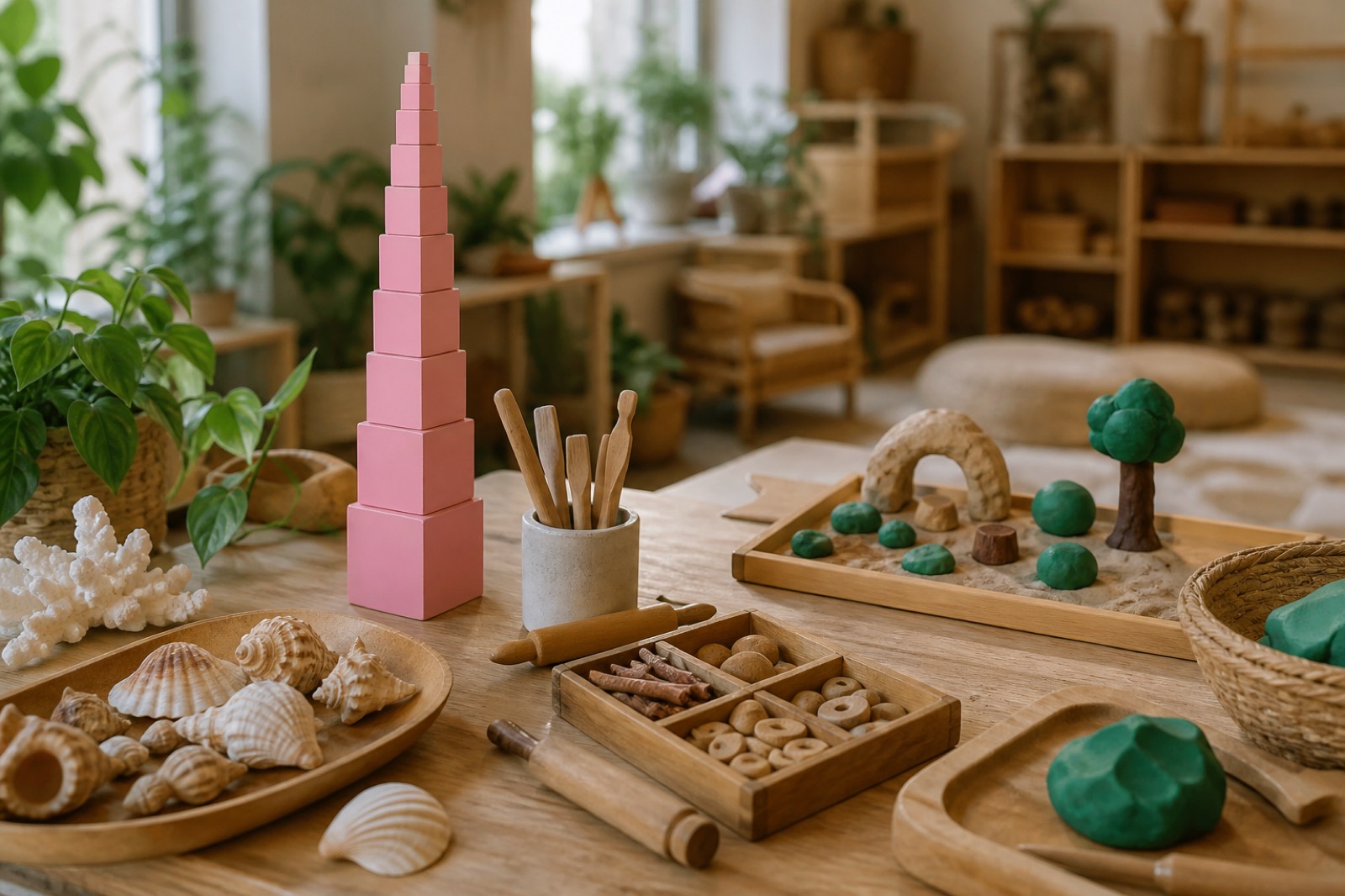
Sensorial materials: the pink tower & knobbed cylinders
Grading blocks and cylinders by size teaches seriation, dimension, and visual discrimination, early math hiding inside the senses.
Sandpaper letters & the movable alphabet
Tracing textured letters links sound, sight, and touch; the movable alphabet lets children build words before their hands can write them.
Number rods, spindle boxes & golden beads
Concrete quantity work makes counting, place value, and the meaning of numbers tangible before they become abstract symbols.
Grace & courtesy + care of the environment
Practicing greetings, waiting turns, watering plants, and tidying shelves builds empathy, responsibility, and belonging.
Nature study & botany/zoology puzzles
Classifying leaves, matching animal cards, and a living nature table invite careful observation and a scientist's curiosity.
Reggio Emilia
The image of the capable child · the environment as third teacher · the hundred languages
Reggio-inspired practice sees children as strong, curious, and full of potential. Learning is emergent, it grows from children's own questions through long-running projects, and children express understanding in a "hundred languages": clay, wire, paint, light, movement, and words.
Emergent, project-based
Curriculum follows children's interests, unfolding as investigations that can last days or weeks.
Environment as teacher
Natural light, real materials, and beautiful arrangements provoke thinking without a word from an adult.
The hundred languages
Children represent ideas through many media, drawing, sculpture, drama, music, not just talking and writing.
Documentation
Photos, transcripts, and displayed work make children's thinking visible and drive the next steps.
In practice
Provocations on the table
An intriguing arrangement, shells beside magnifiers, or paint chips next to leaves, invites children to notice, wonder, and investigate on their own terms.
Long-term project work
Following a shared question ("Where do puddles go?") through days of inquiry weaves in prediction, discussion, and real research across every domain.
The atelier: clay, wire & paint
A studio space stocked with expressive materials lets children shape ideas with their hands, building creativity alongside fine-motor strength.
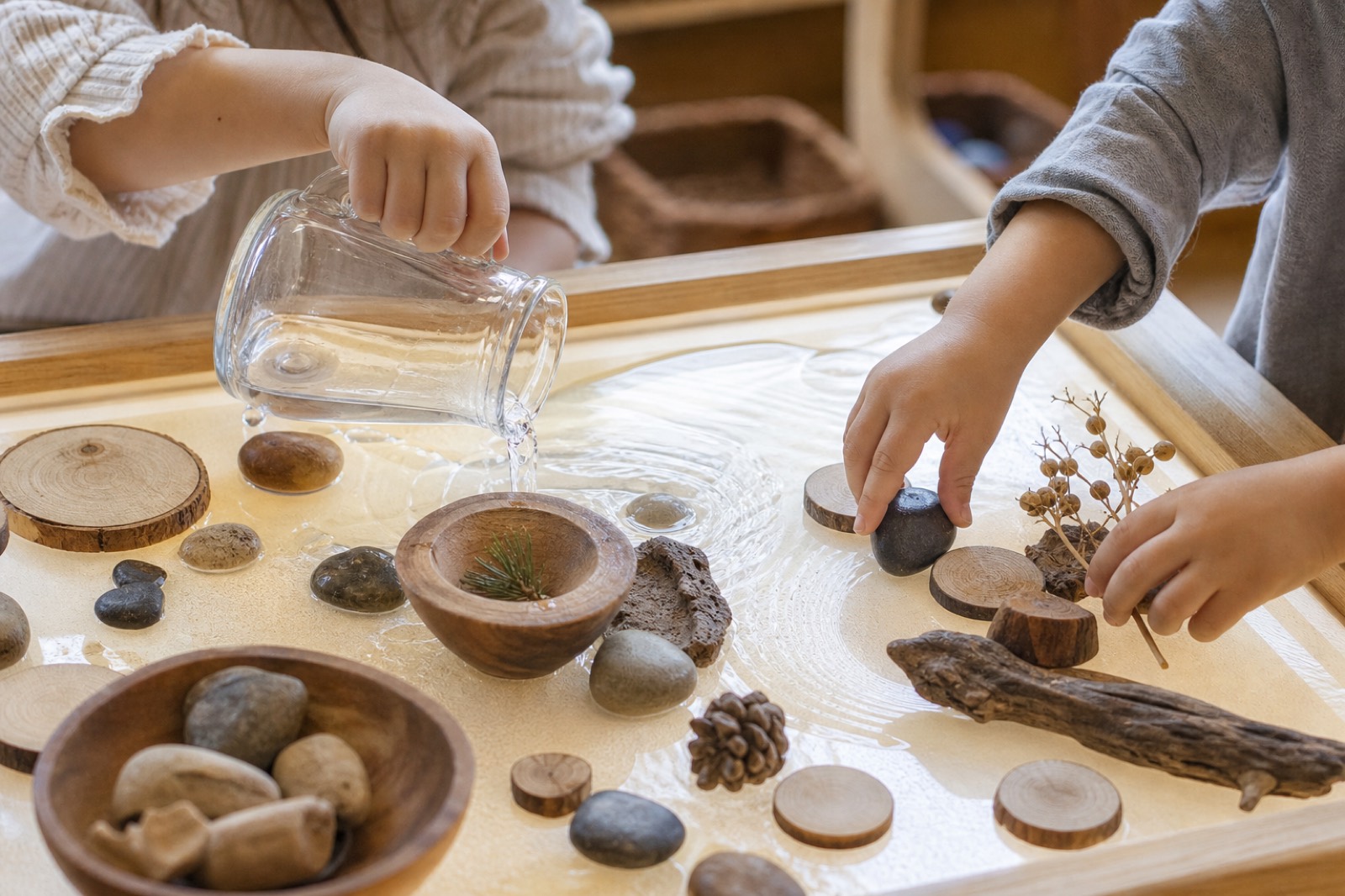
Light table, mirrors & loose parts
Arranging translucent shapes and natural objects surfaces pattern, symmetry, and reflection, math and science through play and light.
Revisiting documentation together
Looking back at photos and drawings of yesterday's work invites children to narrate, reflect, and plan, powerful language and metacognition.
Negotiating a group build
Deciding together how to construct a marble run or a fort calls for listening, compromise, and shared problem-solving.
Schema play
Reading the repeated patterns in how children play
Schemas are the repeated patterns of behavior you see children return to again and again, dropping food from a highchair, wrapping every doll in a blanket, spinning in circles. Far from random, they're a child's way of testing an idea about how the world works. Spot the schema, and you can feed it with just the right materials.
Trajectory
Transporting
Enveloping & enclosing
Rotation
Connecting & disconnecting
Transforming
You don't have to choose just one
These approaches share far more than divides them: a deep respect for the child, a belief that play is serious work, and a commitment to nurturing every domain at once. Many educators blend them, a Montessori-style prepared shelf, a Reggio-inspired provocation, and a schema-aware eye for what a child is really practicing.
Start by observing. Watch what a child returns to, name the domains it's building, then offer materials that stretch it a little further. That loop, observe, name, extend, is the thread running through all three.
Next in the series
Why does the UK use seven areas of learning while the US uses six domains? Read the companion article for a side-by-side breakdown. Start with the domains guide if you haven't yet.
Bloomily for your program
One useful email, when there’s something worth saying.
New guides for childcare and camp operators. No drip campaign, no noise.
See it with your name on the door.
Book a demoSet up in an afternoon.