Published
How to teach SEL: evidence-based strategies that work
Knowing the CASEL 5 is the start. This is the practical part, how to teach and reinforce each competency day to day, drawn from what the research says actually moves the needle.
Teach it, and live it
SEL lands best when explicit lessons are backed up by what children see modeled all day long. You need both.
Teach skills explicitly
Set aside real time to name, explain, and practice specific skills, the same way you'd teach any other part of the curriculum, so children know exactly what they're working on.
Model through everyday teaching
Children learn by watching you. How you manage frustration, listen, or repair a conflict teaches SEL constantly. Narrate it out loud, "I'm stuck, so I'll take a breath and try another way", and they absorb the process.
Don't wait for a crisis to teach skills. If bullying is only ever discussed after an incident, children learn that SEL is about avoiding trouble, not building a life skill.
Make it SAFE
Across the research, the SEL efforts that work best share four features. CASEL captures them in one acronym: SAFE.
Sequenced
Connected activities that build step by step and revisit key ideas as children grow.
Active
Hands-on methods, games, role-play, small-group work, so children practice, not just hear about, skills.
Focused
Dedicated time set aside specifically for developing social and emotional skills.
Explicit
Clear, named targets so children know which skill they're learning and why.
Strategies for each competency
Tap each competency for classroom-ready strategies you can use tomorrow. They map directly to the CASEL 5 from Part 1.
1Self-awareness
Helping children notice and name what they feel
▾
- Use stories to discuss how characters might be feeling and why.
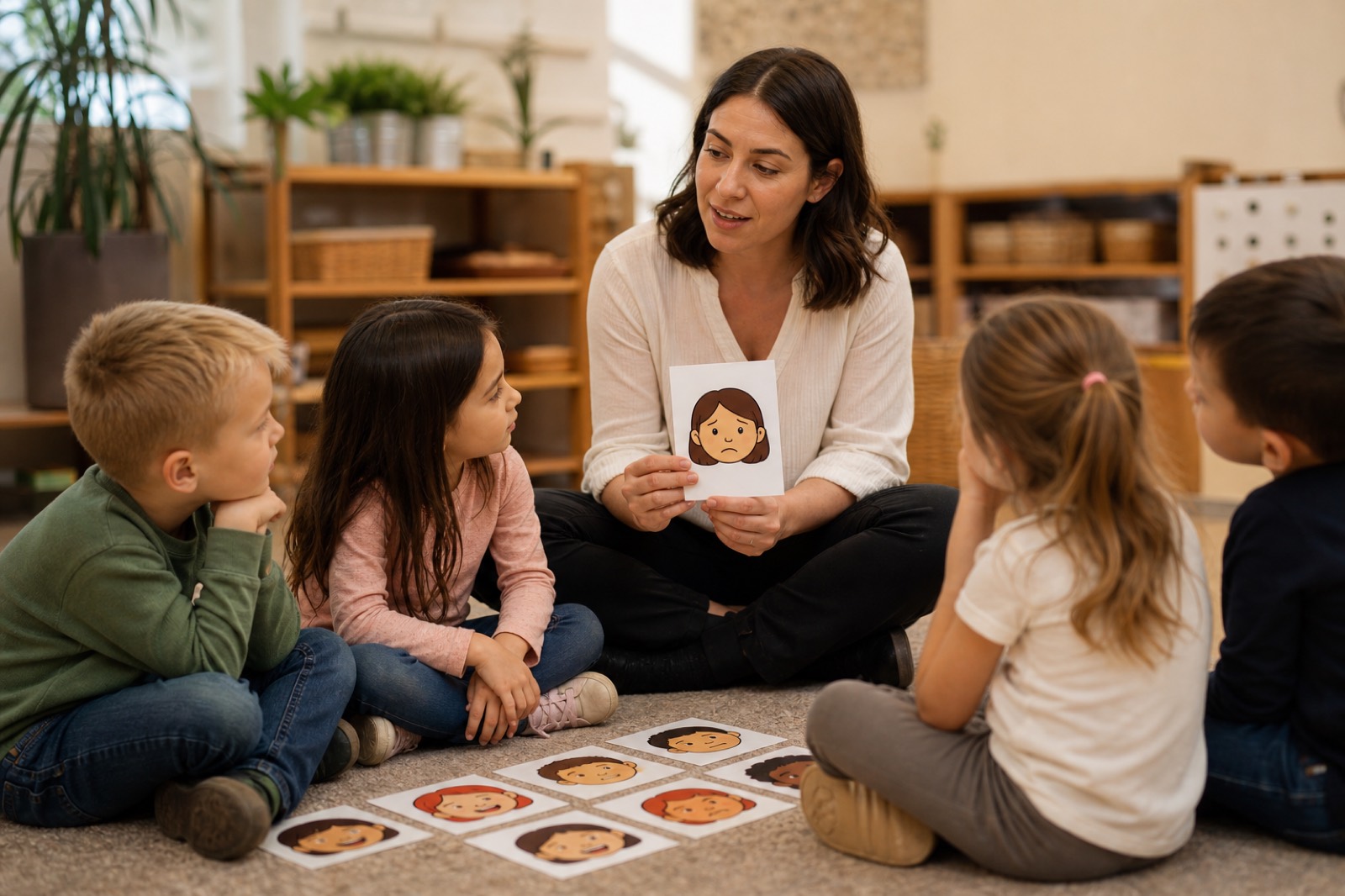
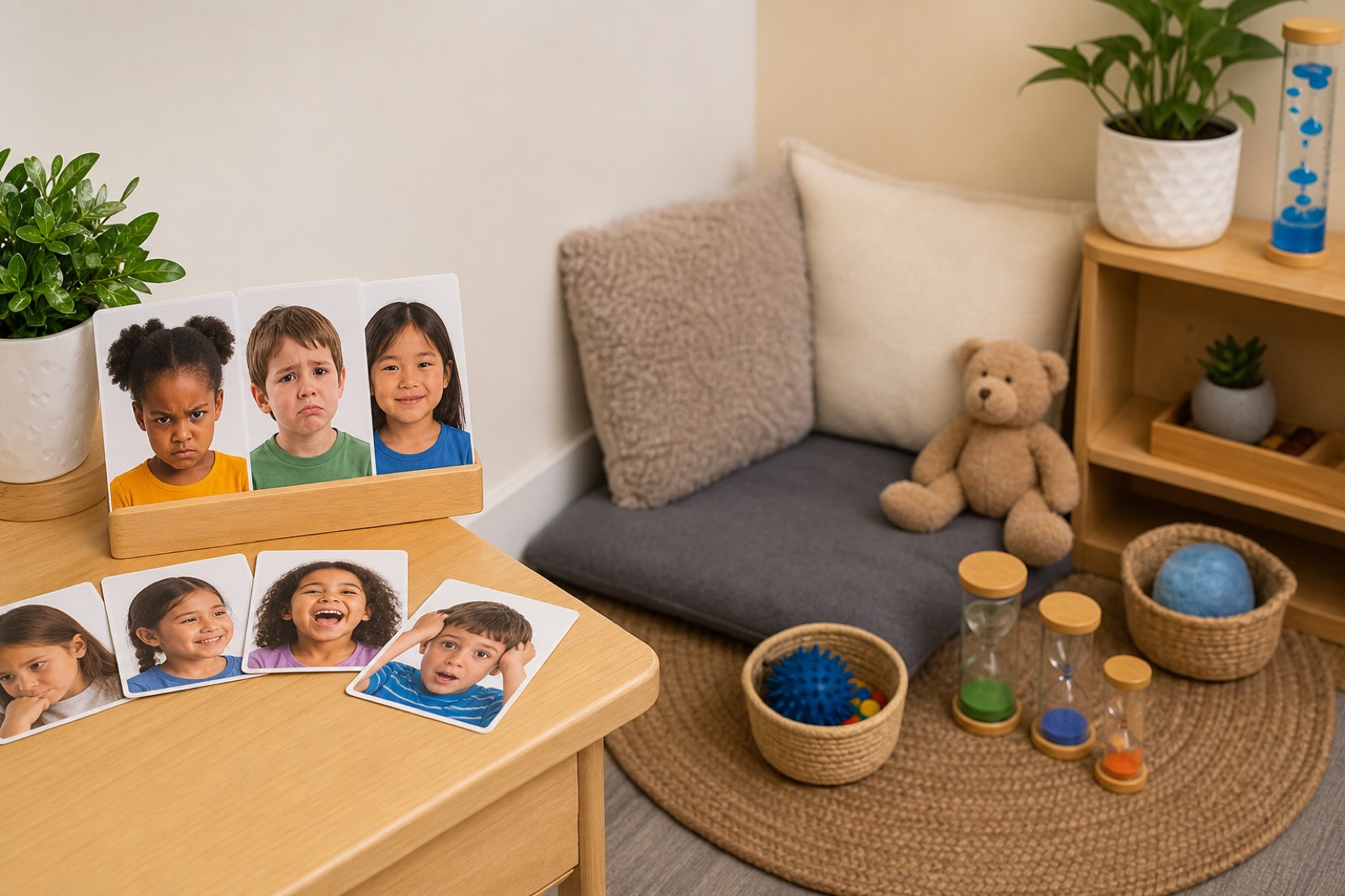
- Use mirrors, photos, and pictures to talk about what happens to faces and bodies during different emotions.
- Offer supportive prompts for children who find feelings hard to voice: "It looks like you might be feeling sad, can you tell me what happened?"
- Name the emotion. Simply putting a word to a feeling helps children understand it more clearly.
- Keep a "feelings display" in the classroom children can point to or check in with.
2Self-management
Building the tools to handle big feelings
▾
- Teach self-calming strategies, walking away, counting to ten, taking slow breaths.
- Help children read their body cues, a racing heart, hot face, shaky hands, so they can catch a big feeling early and talk it through before reacting.
- Use images and metaphors to make it concrete: a balloon filling until it bursts, or a volcano building up pressure.
The Turtle Technique
A well-known, research-informed way to help young children calm down when they feel angry. The teacher explains how a turtle can tuck into its shell, and children can do the same when big feelings rise.
- Recognize the feeling, "I'm getting angry."
- Go "into your shell", pause, put your head down or hug yourself.
- Take three deep breaths and think a calming thought: "I can calm down."
- Come out when calm and ready to solve the problem.
An older-child version swaps the shell for "Fingers Linked, Time to Think."
3Social awareness
Growing empathy and perspective
▾
- Use literature, poetry, film, and real-life accounts to help children understand how it feels to be bullied, left out, or different, and discuss those difficult experiences together.
- Use circle time to explore others' feelings. Pose scenarios: "Paul wasn't chosen for the swimming team. How do you think he feels?"
- Practice gratitude and noticing strengths in classmates as a regular routine.
4Relationship skills
Cooperation, communication, and repair
▾
- Build a class charter together so children co-own the rules for how they treat each other.
- Use group work on projects and tasks that require genuine collaboration.
- Run circle-time scenarios: "How can we help someone who feels left out?" or "What are things that can damage a friendship?"
5Responsible decision-making
Thinking problems through
▾
- Mind-map solutions aloud as a group, identify the problem, then brainstorm options together.
- Weigh the pros and cons of a situation before deciding.
- Encourage children to try a solution and see what happens; if it doesn't work, they pick another from the list, with plenty of support.
- Start when calm. Problem-solving works best when children are relaxed; if a child is very upset, help them settle first or return to it another day.
Reinforce it across the whole school
When messages, routines, and strategies line up across classrooms and the wider school, children learn and apply social and emotional skills faster and more deeply. SEL taught in isolation, only in one lesson slot, disconnected from everything else, rarely sticks.
Whole-school ideas
- A school council or action group with representatives from across the school.
- Assemblies devoted to social and emotional themes.
- Systems that notice and reinforce SEL in action, points, peer nominations, praise postcards home.
- Calm-down spaces and problem-solving areas, with adult or trained peer-mediator support.
- Behavior and anti-bullying policies aligned with your SEL approach.
Partnering with families
- Invite parental input when drafting the behavior policy.
- Support parents to develop SEL skills at home.
- Involve families in SEL learning opportunities.
- Talk about children's SEL growth, not just academic attainment, at check-ins.
Plan, support, and monitor
Even a strong program isn't a guarantee, implementation is what makes the difference. A few principles keep it on track.
Establish a shared vision for SEL that connects to, rather than competes with, your other priorities. Involve teachers and staff in the planning. Provide training and support so everyone feels ready. Prioritize the quality of delivery, teacher preparedness and enthusiasm are linked to better outcomes, and keep monitoring and evaluating the impact so you can adapt with care.
Free download: the SEL Activity Pack (ages 3–5)
Five printable worksheets, one per CASEL competency, ready to photocopy for tomorrow's lesson. All About Me, My Calm-Down Plan, Fair or Not Fair? The Kindness Flower, and What Happens Next?
The full series
Start with Part 1: What Is Social-Emotional Learning? The CASEL Framework Explained for the what and why behind these strategies.
Bloomily for your program
One useful email, when there’s something worth saying.
New guides for childcare and camp operators. No drip campaign, no noise.
See it with your name on the door.
Book a demoSet up in an afternoon.