

Why We Chose Childcare: A $60B Underserved Market

When we started Bloomily, the reaction from the broader tech world was predictable: "Childcare? You could be building AI agents. What are you doing?"
We hear some version of this regularly. Here's our actual answer.
First, the reaction itself tells you something. When smart engineers hear "childcare software" and immediately dismiss it, that's not a red flag about the market. That's a moat.
Every great vertical SaaS company started with this exact dynamic: smart people underestimating a market because it didn't sound sexy enough.
Toast was restaurant POS software. ServiceTitan was HVAC and plumbing scheduling. Dentrix was dental practice management. Procore was construction project management.
None of these sounded exciting in a pitch meeting. All of them became massive businesses. Toast is worth over $30 billion. ServiceTitan IPO'd at $9 billion. Procore is at $12 billion.
You know what they all had in common? They served fragmented industries full of small businesses that had been ignored by good engineering talent for decades.
Sound familiar?
The Numbers on Childcare

The childcare industry in the United States generates over $60 billion in annual revenue. There are roughly 500,000 childcare programs — centers, preschools, family childcare homes, and camps.
About 12 million children under the age of 5 are in some form of regular childcare arrangement.
The average childcare center has 75 children and bills somewhere between $800 and $2,500 per child per month depending on geography and age group. A mid-sized center with 100 kids at $1,200/month average is doing $1.44 million in annual revenue.
These are real businesses. They have payroll, compliance requirements, billing systems, parent communication needs, staff scheduling, enrollment pipelines, and licensing regulations that vary by state.
And the vast majority of them are running on some combination of paper, Excel, a decade-old software platform, and a director who holds everything together through sheer willpower.
We're not exaggerating about the technology gap. We've visited centers that keep attendance on paper clipboards. We've seen enrollment managed in Gmail. We've watched a director use three different apps — one for billing, one for parent messaging, one for attendance — none of which talk to each other.
One director showed us her "system" for tracking staff certifications. It was a filing cabinet. With actual manila folders. She checks them manually every quarter to see what's expiring.
This isn't a market that needs a marginal improvement over existing software. This is a market where the bar is on the floor.
Why Hasn't Someone Already Won It?
"Okay," skeptics say, "but if the market is so good, why hasn't someone already won it?"
Great question. A few reasons.
First, the talent allocation problem. For the last 15 years, the best engineers have flocked to consumer social, fintech, crypto, and now AI. Building SaaS for childcare directors was never going to win the talent war against building self-driving cars. So the engineering quality in existing childcare software reflects that. It was built by people who ended up in childcare software, not people who chose it.
Second, the sales motion is hard. You're selling to small business operators who are busy from 6 AM to 6 PM, skeptical of technology (because past software has failed them), and making decisions with tight margins. You can't just run a Facebook ad campaign and expect demo bookings. You have to actually understand their world, earn their trust, and prove that switching to your platform won't destroy their operations during the transition.
Most VC-backed startups don't have the patience for that. They want to see hockey stick growth in 18 months. Childcare is a trust-and-consistency play that rewards patience.
Third, the product scope is enormous. A childcare center doesn't need one tool. It needs an entire operating system: enrollment, billing, attendance, parent communication, daily reports, staff scheduling, compliance tracking, meal planning, assessments, photo sharing, and more. Building just one of those features well is a significant effort. Building all of them, integrated, working together, for a non-technical user? That's a multi-year engineering challenge.
Most companies in this space built one or two features, got to a few hundred customers, and then couldn't expand the product fast enough to retain them.
The Moat: Switching Costs
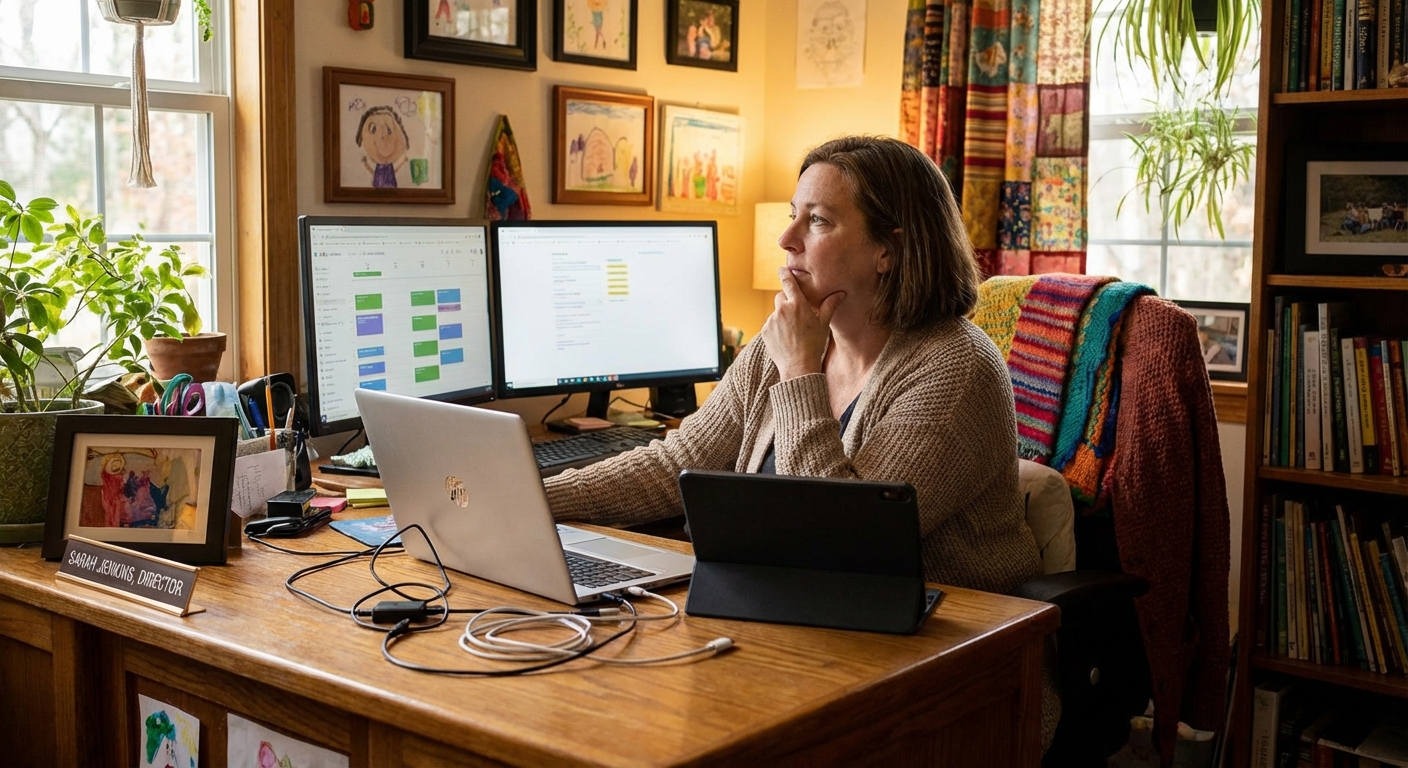
In SaaS, switching costs are everything. And childcare has some of the highest switching costs of any vertical.
When a director considers changing their software platform, here's what they're facing:
Migrating years of enrollment data, family records, billing history, and immunization documentation. Retraining a staff that may include assistant teachers who are not comfortable with technology. Communicating to 80+ families that they need to download a new app and set up new accounts. Risking a billing disruption during the transition that could mess up tuition payments.
All of this while still running a center full of children every day.
The average director we've talked to estimates that a full software migration would take 2–4 weeks of extra work. Most of them don't have 2–4 extra hours, let alone weeks.
So what does this mean? It means that if you get it right — if you build a platform that genuinely works and earn a director's trust — they stay. For years. The churn rates in established childcare software are remarkably low, often under 5% annually. In SaaS terms, that's exceptional.
It also means the competitive dynamics are different. You're not competing on who has the flashiest demo. You're competing on who can handle the transition most painlessly and then deliver consistently after that.
The Impact

There's one more thing the skeptics don't see: the impact.
When we build software that saves a director an hour a day on administrative work, that's an hour she can spend in classrooms with children. Or an hour she can go home to her own family instead of staying late to update spreadsheets.
When we build a notification system that actually gets parents to read about their child's day, that's a family conversation at dinner that wouldn't have happened otherwise.
When we build a compliance tracking system that alerts a director 60 days before a staff certification expires, that's a potential licensing violation that never happens.
Our team spent years building ride-sharing software. The impact was real — people got where they needed to go. But there's a different weight to building something that affects how children are cared for.
We're not saying our work is more important than anyone else's. We're saying it's more important than the tech world thinks it is. And that gap between perception and reality is exactly where the opportunity lives.
Who's Making the Strange Choice?
So yeah. The tech world thinks building for childcare is a strange choice.
Meanwhile, teams elsewhere are building AI wrappers and chatbot interfaces for markets where 50 competitors launched last month. They're chasing the same talent, the same customers, the same investors.
At Bloomily, we're building software for a $60 billion industry where the incumbents were built on Windows XP-era architectures, where the best engineers never showed up, where customers are desperate for something that actually works, and where switching costs create natural retention that most SaaS founders would kill for.
You tell us who's making the strange choice.
The real strange thing isn't that we chose childcare. It's that this market has been ignored by strong engineering teams for this long. The opportunity is enormous specifically because talented people keep looking at it and saying "really? childcare?"
Every time they say that, the moat gets a little deeper.